
Et al.
2831 Mission St. San Francisco, CA 94110
Mission
Monday | Closed
Tuesday | Closed
Wednesday | 12:00 PM - 6:00 PM
Thursday | 12:00 PM - 6:00 PM
Friday | 12:00 PM - 6:00 PM
Saturday | 12:00 PM - 6:00 PM
Sunday | 12:00 PM - 6:00 PM
Saturday, June 13 | 1:00 PM
Walkthrough of Neighbors exhibit: artist Daniel Alejandro Trejo will lead a Spanish-language walk-through of the show.
Thursday, June 18 | 5:30 PM
Screening, doors at 5:30 PM, screening at 6:00 PM
Mixtape Cartoon Night: Screening cartoons selected by the Neighbors exhibit artists Daniel Arthur Mendoza and Daniel Alejandro Trejo. Grab a seat on our lawn chairs and blankets as we eat popcorn and watch the offbeat cartoons that have influenced their art.
Sunday, June 21 | 5:30 PM
Performance/Book Launch doors at 5:30 PM, performance at 6:00 PM
“Shut into a Shadow,” with Contraption — A Reading Set. Featuring—Yates Cessna, a working writer who lives in San Francisco; Joseph Simas, author most recently of Shuffle (Introducing—Anime Titles); Michael Schuffler, poet, whose latest book is Mascot Anastasia (prone as snowmen).
Thursday, July 9 | 6:00 PM
Lecture celebrating the release of The Alchemical Imagination: Eliza Swann explores alchemy and creative mystery through figures like John Dee, Forrest Bess, and Diane di Prima, framing alchemy as a field where radical experimentation, imagination, and devotion converge
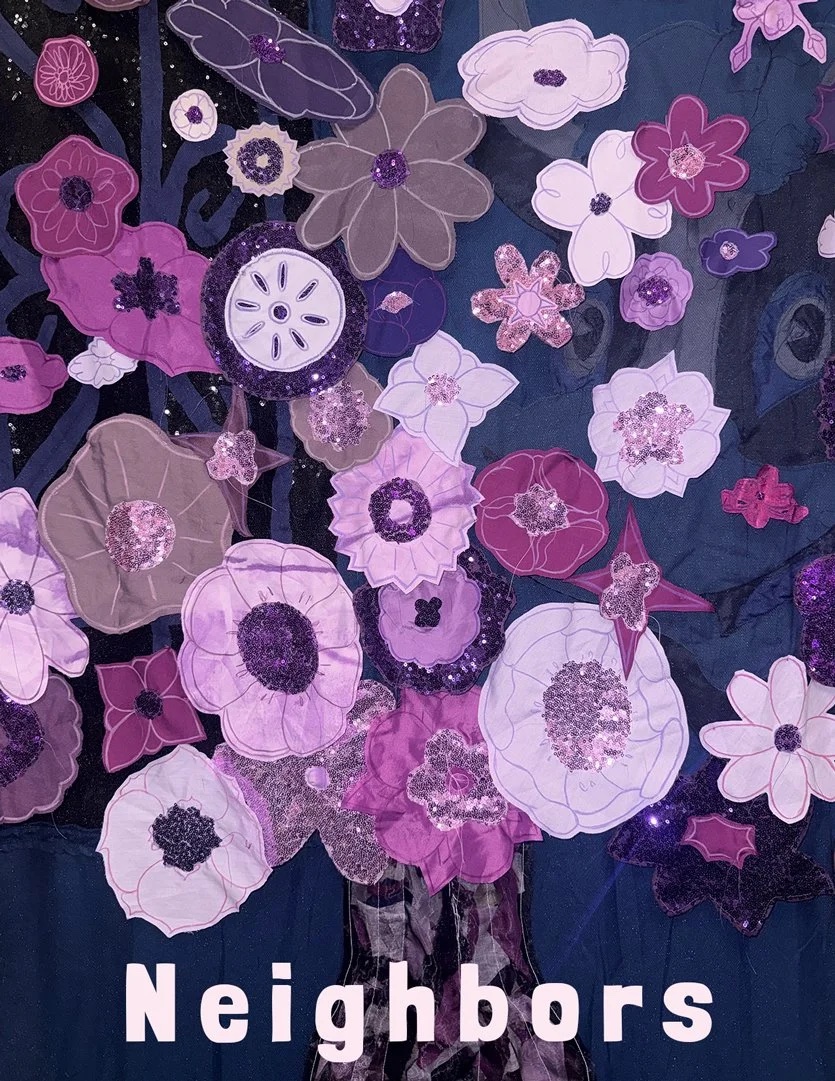
Neighbors: Daniel Arthur Mendoza and Daniel Alejandro Trejo | May 15 - June 27, 2026
I met Daniel Mendoza and Daniel Trejo separately a few years ago. We shared informal chats and visits, connecting at openings and in the arts community. Some overlapping themes would emerge in our talks: the Sacramento area where we were born, being of Mexican-American background, how ideas of community and representation came up in our work.
We also talked a lot about cartoons. Daniel Mendoza referenced the Three Caballeros, a 1940’s animation by Disney that I also watched a lot of growing up. In the movie the Disney characters visit Latin American countries and interact with stereotyped characters, singing songs in Spanish and Portuguese ostensibly to learn about their cultures. The movie did not age well.
I found out that the Three Caballeros was the Disney studio’s contribution to the Good Neighbor policy developed by FDR: a foreign policy that emphasized cooperation and cultural exchange with the nations of the Americas during WWII. This historical note hit me hard as I thought about ICE raids, state sanctioned violence and anti-immigrant and anti-communities of color rhetoric running high, as it does today. What does it mean to be someone’s neighbor? Can we still be good neighbors with each other?
A neighbor can be a friend. They can be someone who understands you, someone you share history with. Maybe they are someone you trust to feed your cat when you are out of town. A neighbor can also be a stranger. There can be walls that separate you from your neighbor, or you might close the blinds to keep out prying eyes.
Neighbors is a presentation of hope and caution. It is the imagining of a joyful future of allyship, safety and community. It is also the histories that are tucked away behind walls and in the cracks.
-Justin Mata
Daniel Arthur Mendoza (b. 1989, Sacramento, California) received his MFA from UC Riverside in 2022. He received a BA in Studio Art at UC Davis, and attended the Chautauqua Institution Schools of the Fine and Performing Arts in Chautauqua, New York in 2013. His work has been exhibited most recently at Noon Projects (Los Angeles, CA), The Mistake Room (Los Angeles, CA), Human Resources Los Angeles (Los Angeles, CA), Southern Exposure (San Francisco, CA), and Hawthorn Contemporary (Milwaukee, WI) among others. He was an artist in residence at the Headlands Center for the Arts in Fall 2025. He is currently living and working in San Francisco, California.
Daniel Alejandro Trejo (b. 1991) is a visual artist with an adjacent curatorial practice. He received his degrees in Art Studio and Art History from the University of California, Davis. Trejo’s work has been presented in a variety of contexts, including at Human Resources (Los Angeles), The Crocker Art Museum (Sacramento), Gallery 12.26 (Dallas) and Material Art Fair (Mexico City). His work and curatorial projects have been featured in Hyperallergic, Open Space for SFMOMA and Ceramics Monthly.
Justin Mata is an artist and cultural worker living in San Francisco. His artworks and videos have been shown at such venues as El Museo del Barrio (NYC), NURTUREart (Brooklyn), Northwest Film Forum (Seattle) and Adobe Books Backroom Gallery (SF). He received his BFA from California College of the Arts (SF) and his MFA from the School of Visual Arts (NYC).
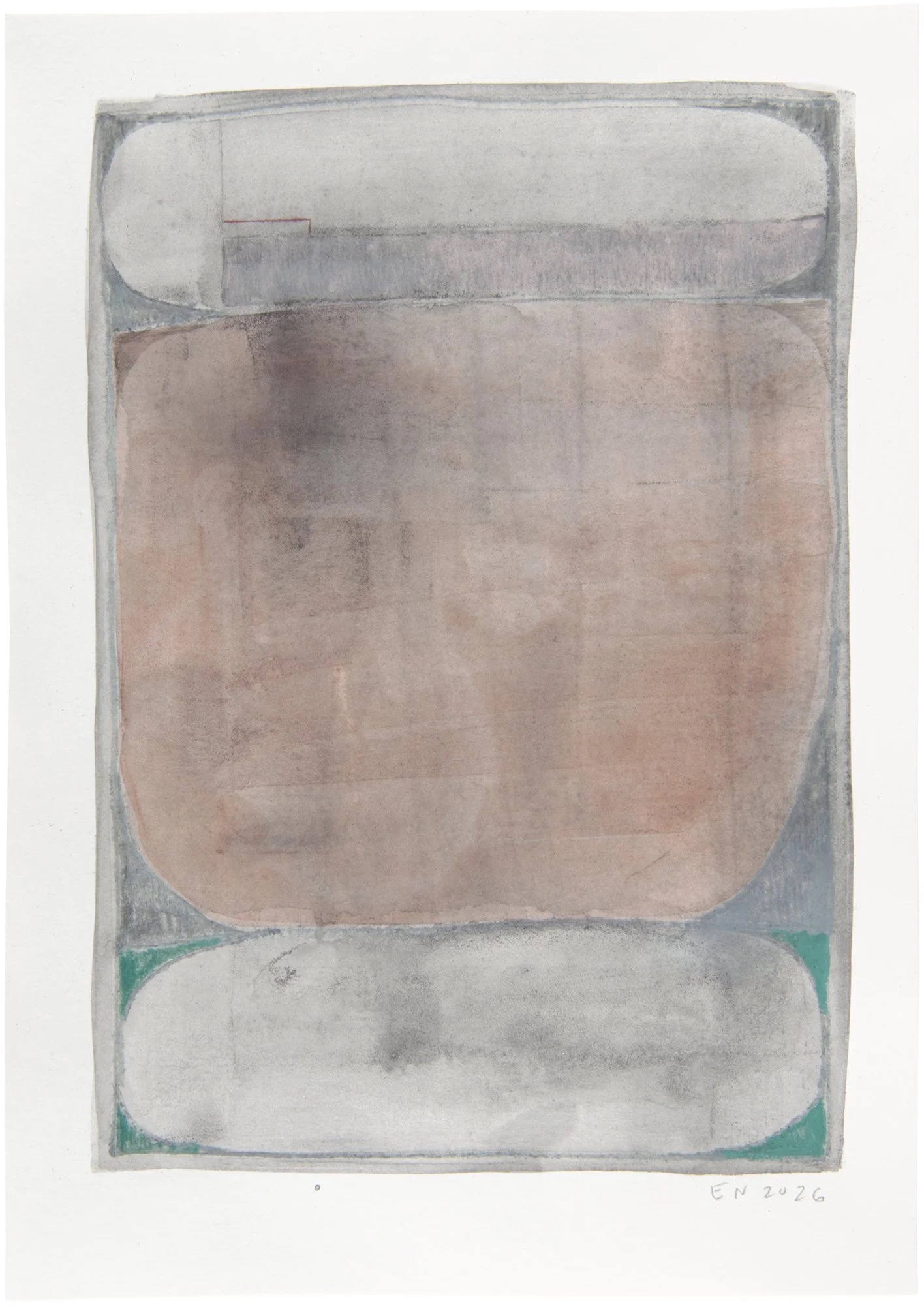
Elisabeth Nicula: Possible Outcomes | May 15 - June 27, 2026
How to Know the World
We could walk across the city of San Francisco.
We could forget to remember the art world.
We could finish our spaghetti and meatballs and not have nightmares.
All sorts of outcomes are possible, after all.
Elisabeth has impressed upon me that her paintings come from a part of her that has no language. If we were ancient Greeks, we might imagine this part as an actual place, maybe one that travels around her body, all over its cavities and surfaces and even a short distance away from it at times, highly susceptible as it is to spatial and volumetric shifts. Maybe this place, in certain moments when the afternoon light is slanting down from the hills, would look like what the paintings look like. Because they are wavy, because Elisabeth made them on what she describes as “not officially watercolor paper” and didn’t flatten them (because she didn’t feel like it and also because it seemed right that they not be flat, which is maybe why she didn’t feel like it), we can more easily imagine them as depictions of three-dimensional spaces. Rooms, for example, that we might wander into, lost in discussion and not paying all that much attention to that fourth dimension, time, which is, like us, always moving. Or so I imagine.
I walk up Twin Peaks to put myself between the ocean and the bay. This is the opening sentence of “Dioramas,” the first piece of Elisabeth’s I encountered as her editor, when I was at Open Space, in 2017, when Elisabeth for me was an artist living in San Francisco, not yet one of the people I love most in this city. Then, as now: Elisabeth walking, in relation to something above and something below. Her linguistic snapshots of details big and small alternate with digital (two-dimensional) dioramas, visual snapshots of the Bay Area. If you were walking with Elisabeth, she would be paying attention like this, pointing respectfully, not touching (maybe just a few of the blackberries). Maybe you would see, or even feel, the dense air massing over the ocean, creating an atmospheric layer cake; depending, again, on the quality of the light, this cake might be shot through or even infused with fantastical pinks, yellows, blues. If you were alone, in which case probably on your phone, you might not notice any of this, but some of it would certainly notice you. You would be in relationship with everything around you, whether you were interested in those relationships or not.
We keep repeating things, all of us. As if we’re trying to explain something to ourselves, or maybe just remember it, like the notes Elisabeth writes to herself on scrap paper when she’s in the shower, sticking them to the damp wall as a temporary measure so that when she later dries them out they are also not flat. I don’t know what part of her body these notes come from, whether because she also doesn’t know, or simply hasn’t thought to tell me. Maybe they are just passing through, and this is why they have to be written down. It’s nice how much art is contained within the body. All art is derived from the body. There are interesting notes everywhere. That’s Elisabeth, again, in “A Body That’s All Surface,” published on The Back Room in 2024. You see, she has already written everything that needs to be explained here, to herself and others.
The ancient Greeks also thought up utopias, not like the ridiculous, astonishing early Americans who insisted on making them some place, but as no place: something perfect, and therefore impractical, maybe even imaginary, like your friends, like your thoughts, like the art you make when you aren’t making other things. An idea for another way of being, in which collaboration is the dominant force.
If things are delicate enough, they can coexist without getting in each other’s way. They might even enjoy their proximity. All sorts of outcomes are possible. It’s like when humans and wild animals become friends, they have to settle for quantum entanglement. I suppose this is true even when they aren’t friends. But that’s not what we’re talking about, not in this room, anyway, which is like a heart, in that each can get terribly lonely.
There’s something moving so lightly over your skin, a waveform maybe. It doesn’t understand your boundaries, or its own. But that’s only because it’s interested in you.
—
Claudia La Rocco’s books include the novella Drive By, published by Elisabeth Nicula’s Smooth Friend, and Constellations Are Totally Imaginary Things, a collection of miscellanea forthcoming from Soberscove Press. She collaborates frequently on interdisciplinary projects, including animals & giraffes, the improvisation collective she leads with musician/composer Phillip Greenlief.
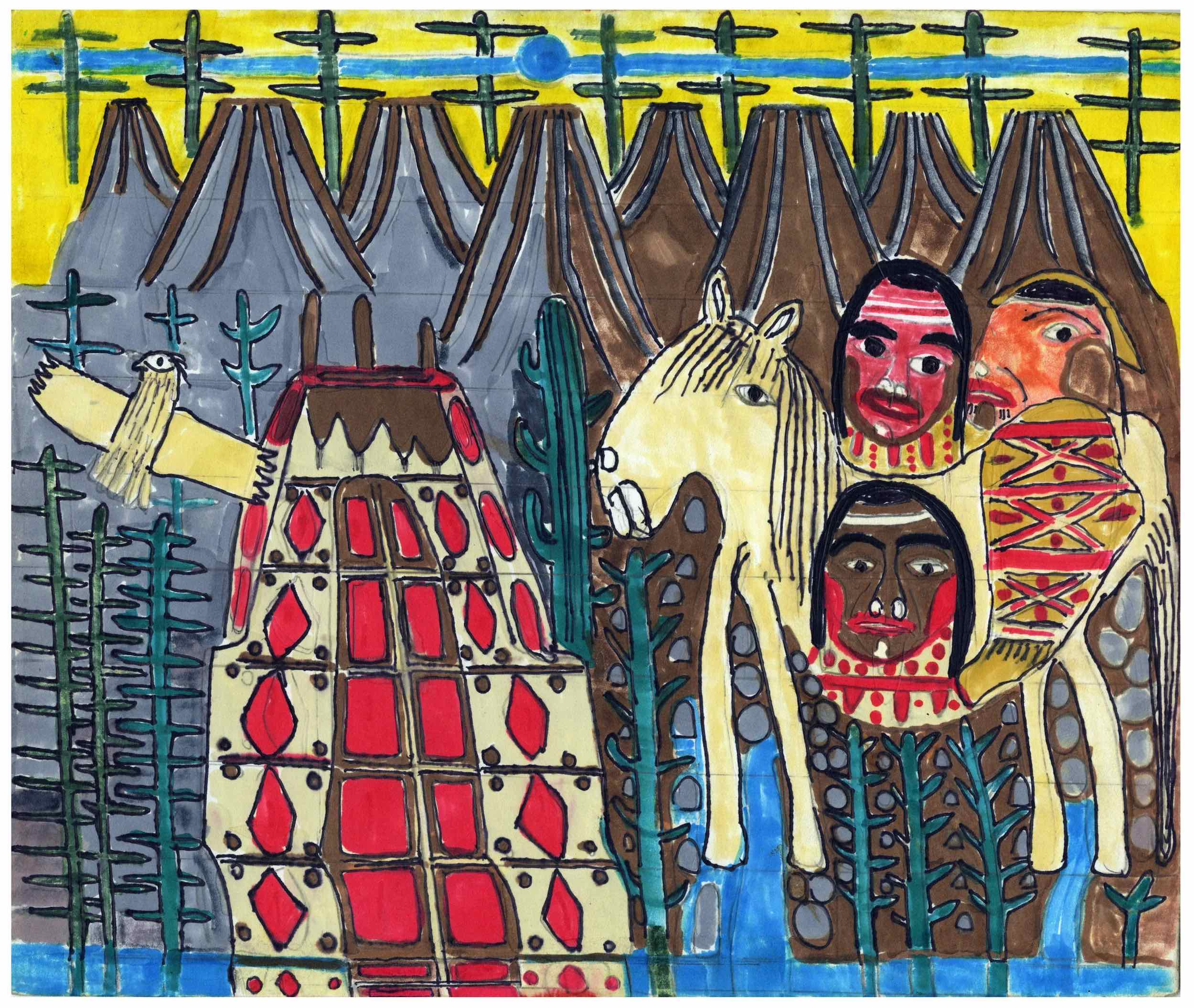
Peter Cordova | May 15 - June 27, 2026
Mountains, rocks, the sun and the sky, cacti, people and animals populate Peter Cordova’s dense, tightly structured drawings. Cordova’s sculptures animate the people and animals. There are constant inversions of color: one half of the mountain range might be grey on brown, the other half brown on grey; in some the sky is blue and the sun yellow and in others the reverse. The people meld with the animals, with the stones.
Peter Cordova appears courtesy of Creativity Explored. From Creativity Explored:
Peter Cordova (b. 1966) has a decades-long practice specializing in ceramic sculpture and illustration. In his work, his biggest references are his Filipino heritage and his interest in Indigenous American cultures. He is also inspired by nature, National Geographic, and Channel Nine. The brother of a figurative artist, and a proud member of Creativity Explored for three decades and counting, Cordova invests as much time in supporting and amplifying other artists as he spends on his own making. His priority in community-building exemplifies his belief in wisdom as an important resource.
Cordova begins all of his work in pencil, drawing out a grid to orient his subjects. He employs this same method with ceramics, tracing a grid into the clay. His detailed depictions of cultural iconography are illuminated by his application of rich, earthy palettes. In his ceramic practice, Cordova’s hand-building technique emphasizes texture and form, his sculptures often speaking directly to the scenes he depicts in his works on paper. In regard to his artistic career, Cordova states, "I want to speak for myself through my art. I try to share my heritage with other people.”
Cordova has participated in over seventy exhibitions nationally throughout the span of his career. His solo show To the Place Where I Grew Up was exhibited in the Creativity Explored gallery in 2022, featuring dozens of his dynamic works on paper. His work was most recently featured in the exhibition Karl: Unseen Histories: AAPI Voices in Contemporary Art, which was on view at Levi’s Plaza in 2025. Cordova’s work can be found in the permanent collection of SFMOMA and the Oakland Museum of California